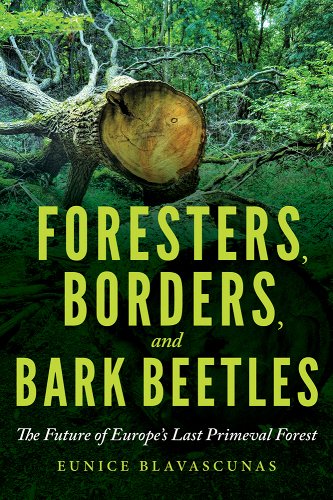
In Foresters, Borders, and Bark Beetles: The Future of Europe’s Last Primeval Forest we encounter foresters, scientists (one an eccentric aristocrat), a “man of the forest,” and activists. Each of four core chapters focuses on one of these figures, usually through a single person, and through their varied commitments to Białowieża, an ancient forest in eastern Poland at the border with Belarus. Eunice Blavascunas weaves the stories of these individuals with the historical background of the region, with attention especially to tensions—around class and national identity—in the post-Communist era. Blavascunas’s ethnographic research took place over more than two decades, so she has had a front row to the dramatic changes at the end of the twentieth century and in the first years of the twenty-first. Through her, we meet Simona Kossak, who kept a pet boar and argued for the rights of animals within the forest, and also the “post-peasant” Leszek, who declares himself so much a man of the forest that he could be dropped into it anywhere and know exactly where he is. For all Leszek’s claims about his intimate knowledge of Białowieża, however, Blavascunas has trouble getting him into the forest. And like Leszek, who seems to talk more about the forest than spend time within it, for much of the book Blavascunas keeps to the margins of “Europe’s last primeval forest.” I found myself a little frustrated that we didn’t get to know the mushroom, woodpeckers, bison (!) and Norway spruce better; the forest itself disappears against what it means for humans. The forest’s nonhuman claimants come to the fore in the sixth chapter: the spread of the bark beetle has led to confrontations over what the human response should be. For nationalists, “heavily logging Białowieża under the pretext of a bark beetle outbreak became a way to challenge the supremacy of the European Union and secular environmental activists” (154). On the other hand, for environmental activists “the bark beetle was a rewilding agent that let conservationists tell a forest narrative to counter the circulation of nationalist narratives” (167). As this drama unfolds, it becomes clear how the stories of the various stakeholders from the previous chapters come together in the present—and that environmental interventions depend on whose narrative about place is deemed most persuasive.
I’m interested in how religious commitments influence views of nonhuman animals and plantlife, and although Blavascunas rightly centers political and ideological views in telling the story of Białowieża, the divide between Catholicism and Orthodox Christianity is also a shaping force. Perhaps more significant is the difference between a view of the forest as having its own agency and a view that instead sees at as created for human use. As an example of the latter, Blavascunas quotes a Catholic priest as characterizing the activists as working to “radically negate God as the creator of Poland, Poles and Polish women, animals, and plants” (172). The other side asserts that “the forest must be freed to become to what it will” (168), even if that means change that runs counter to what humans might want.
In the introduction, Blavascunas characterizes Białowieża as “both pristine and imperiled, ‘already ruined’ and the best hope for knowing a ‘wild’ European forest” (8). This description, especially the first part, strikes me as true for many forests in other places. Moreover, what Blavascunas has shown very effectively is that perceptions of nature (as pristine, imperiled, ruined, wild) are deeply embedded in human histories and political identities.
 Arborilegium